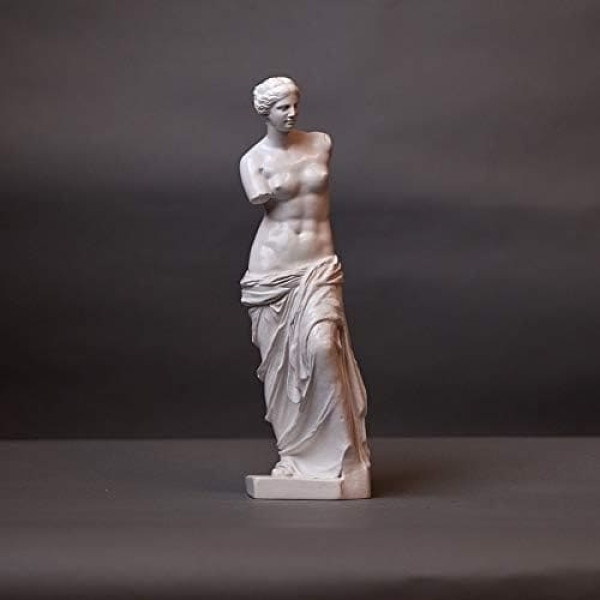
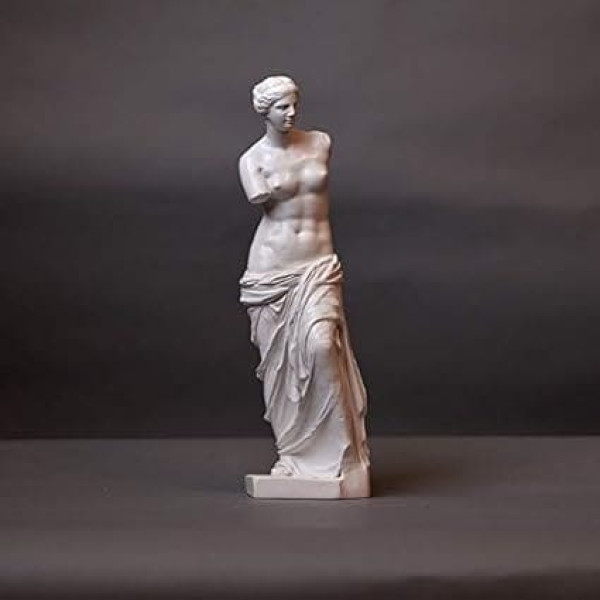
High quality – Our sculptures are made from high-quality Zellan, a material that is characterised by its robust structure and promises a porcelain-like image. Detailed – Our artist has a high attention to detail and spends a lot of time making the sculptures and busts as detailed and clean as possible. Made in Germany – each sculpture is specially cast, patinated and polished in our studio in Potsdam. Size – The sculpture of the Aphrodite has a size of 9 x 9 x 30 cm Gift idea – whether as a gift for a birthday, wedding, house warming or as a business gift, with our sculptures and busts you always leave a lasting impression. A must have for any art lover and history enthusiast. › See more product details; Product description The Venus of Milo (also Aphrodite of Melos), a half-naked statue of the goddess Aphrodite, is one of the most famous examples of Hellenistic art. The original 2.02 metres high and therefore slightly larger than life statue was created towards the end of the 2nd century BC and was discovered on 8 April 1820 on the Cyclades island of Milos in the surroundings of the ruins of a Greek theatre. The statue is now Louvre in Paris. The sculpture is made of marble from the quarries of the Cycladic island of Paros and symbolises the ideal of female beauty. Therefore, it was named after the Roman goddess Venus. Since Venus is the Roman equivalent of the Greek Aphrodite, the statue is also called Aphrodite of Melos (Milos). For many years, the Potsdam artist Alex Agwanjan has lovingly handmade the most diverse sculptures, reliefs and cans made from the materials Zellan or plaster. It attaches special importance to the clean presentation of the finest details, which is possible especially thanks to the material Zellan. Zellan is a synthetic, inorganic impression compound which, when cured, has porcelain-like structure. The material is easy to work with like plaster, paintable or dyeable before use and requires no drying or burning to cure. Zellan is about twice as hard as plaster and also significantly heavier. The use of Zellan allows a very high image accuracy and the finest detail representations. The material has a bright, porcelain-like sound after hardening when tapping. Unlike the slightly grey plaster, Zellan is pure white. All Zellan objects are lovingly patinated and polished by hand by the artist.; Product description The Venus of Milo (also Aphrodite of Melos), a half-naked statue of the goddess Aphrodite, is one of the most famous examples of Hellenistic art. The original 2.02 metres high and therefore slightly larger than life statue was created towards the end of the 2nd century BC and was discovered on 8 April 1820 on the Cyclades island of Milos in the surroundings of the ruins of a Greek theatre. The statue is now Louvre in Paris. The sculpture is made of marble from the quarries of the Cycladic island of Paros and symbolises the ideal of female beauty. Therefore, it was named after the Roman goddess Venus. Since Venus is the Roman equivalent of the Greek Aphrodite, the statue is also called Aphrodite of Melos (Milos). For many years, the Potsdam artist Alex Agwanjan has lovingly handmade the most diverse sculptures, reliefs and cans made from the materials Zellan or plaster. It attaches special importance to the clean presentation of the finest details, which is possible especially thanks to the material Zellan. Zellan is a synthetic, inorganic impression compound which, when cured, has porcelain-like structure. The material is easy to work with like plaster, paintable or dyeable before use and requires no drying or burning to cure. Zellan is about twice as hard as plaster and also significantly heavier. The use of Zellan allows a very high image accuracy and the finest detail representations. The material has a bright, porcelain-like sound after hardening when tapping. Unlike the slightly grey plaster, Zellan is pure white. All Zellan objects are lovingly patinated and polished by hand by the artist.; The Venus of Milo (also Aphrodite of Melos), a half-naked statue of the goddess Aphrodite, is one of the most famous examples of Hellenistic art. The original 2.02 metres high and therefore slightly larger than life statue was created towards the end of the 2nd century BC and was discovered on 8 April 1820 on the Cyclades island of Milos in the surroundings of the ruins of a Greek theatre. The statue is now Louvre in Paris. The sculpture is made of marble from the quarries of the Cycladic island of Paros and symbolises the ideal of female beauty. Therefore, it was named after the Roman goddess Venus. Since Venus is the Roman equivalent of the Greek Aphrodite, the statue is also called Aphrodite of Melos (Milos). For many years, the Potsdam artist Alex Agwanjan has lovingly handmade the most diverse sculptures, reliefs and cans made from the materials Zellan or plaster. It attaches special importance to the clean presentation of the finest details, which is possible especially thanks to the material Zellan. Zellan is a synthetic, inorganic impression compound which, when cured, has porcelain-like structure. The material is easy to work with like plaster, paintable or dyeable before use and requires no drying or burning to cure. Zellan is about twice as hard as plaster and also significantly heavier. The use of Zellan allows a very high image accuracy and the finest detail representations. The material has a bright, porcelain-like sound after hardening when tapping. Unlike the slightly grey plaster, Zellan is pure white. All Zellan objects are lovingly patinated and polished by hand by the artist.
|










![Pack of 10 Dimmable G9 Halogen Bulbs, 40 W 230 V 2800 K G9 Halogen Bulbs for Oven Lamp, Ceiling Lights, Candlesticks [Energy Class F]](https://anete.shop/image/cache/catalog/ext4oc/90/19083374_-9007480-238x238.jpg)